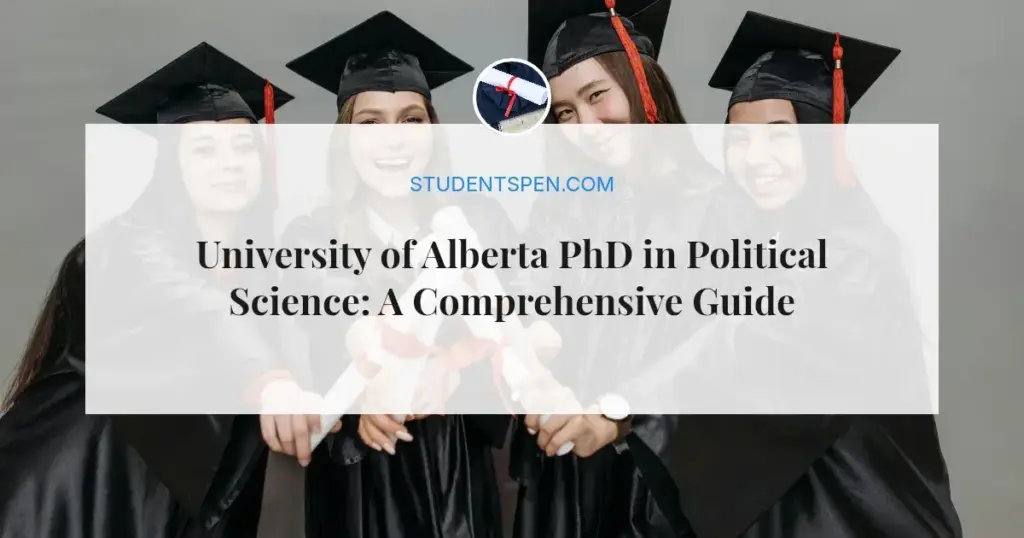
The University of Alberta PhD in Political Science program offers a rigorous academic journey for those aspiring to become leading scholars, researchers, and policy experts. This doctoral program is designed to equip students with advanced knowledge and skills in political science, preparing them for impactful careers in academia, government, and international organizations. The program emphasizes independent research, specialized study, and professional development over a minimum of four years, with a maximum of six years for completion.
Program Strengths and Structure
The University of Alberta’s Political Science PhD program is recognized for its academic excellence and commitment to student success. It provides a supportive environment for doctoral candidates to conduct original research and develop deep expertise in their chosen fields. Key strengths include comprehensive training, opportunities for advanced research, diverse specialization options, and strong faculty mentorship. The program also focuses on preparing graduates for a variety of career paths, both within and outside traditional academic settings.
The program structure is designed to guide students through a progression of academic milestones. This includes completing coursework, passing comprehensive examinations, developing a dissertation proposal, and ultimately defending their completed dissertation. The department encourages students to align their doctoral studies with their long-term career aspirations, offering flexibility and support throughout the process.
Academic Requirements and Specializations
To earn a PhD in Political Science from the University of Alberta, students must successfully complete 18 graduate-level credits, typically equivalent to six three-credit graduate courses. A mandatory course, POLS 680, is required for all doctoral students and is usually offered in the Fall semester. Participation in a Graduate Lab is also essential, as it specifically prepares students for their Comprehensive Examinations.
Students must select two areas of specialization from a range of fields within political science. These options include:
Canadian Politics
This specialization delves into the intricacies of Canadian political institutions, public policy, federalism, political behavior, and democratic governance.
Comparative Politics
Focuses on comparative political systems, democratization processes, state-building, and comparative public policy across different nations.
Gender and Politics
Examines gendered political structures, feminist political theory, representation, participation, and the impact of public policy on gender equality.
International Relations
Research in this area may cover global governance, international organizations, security studies, diplomacy, and the international political economy.
Political Theory
This specialization explores classical political thought, contemporary political philosophy, democratic theory, and issues of justice and ethics.
Coursework beyond the required POLS 680 is typically chosen from 500-level and 600-level Political Science courses offered by the university.
Year-by-Year Program Progression
The PhD program at the University of Alberta follows a structured, year-by-year progression to guide students toward degree completion.
Year 1
The first year is dedicated to completing required coursework, specialized training, and participating in the Graduate Lab. Students also begin establishing initial supervisory arrangements, with the official designation of a supervisor typically occurring by the end of this year.
Year 2
During the second year, students focus on preparing for and completing their Comprehensive Examinations in both of their chosen specialization areas. These examinations are critical for assessing a student’s mastery of their fields and their readiness for advanced research.
Year 3
Upon successful completion of comprehensive examinations, students move on to developing their dissertation proposal and undertaking an oral candidacy examination. This examination evaluates the quality and feasibility of the proposed dissertation project. By the end of Year 3, students must have completed all program requirements except the dissertation itself, achieving ABD (All But Dissertation) status.
Years 3-6
The final years of the program are primarily dedicated to conducting original research, writing the dissertation, and preparing for post-graduation careers. This period also involves opportunities for publishing scholarly work and presenting research findings at academic conferences.
Dissertation Options and Defense
The University of Alberta offers two distinct pathways for completing the doctoral dissertation, providing flexibility for students to choose the format that best suits their research.
Option 1: Traditional Dissertation
This format typically involves a monograph of 50,000 to 80,000 words, structured into four to seven integrated chapters. It includes an introduction, conclusion, bibliography, and any necessary appendices or research data. The dissertation must present original research, demonstrate rigorous analysis, and make a substantial contribution to the field, meeting high scholarly standards.
Option 2: Dissertation-by-Publication
An alternative format allows students to present their research as a series of journal-style papers. This option includes an introduction chapter, multiple publishable research papers, and a conclusion chapter. The key difference lies in the body of the dissertation: the traditional format uses integrated monograph chapters, while the publication format consists of independent, publishable articles.
Both dissertation formats require approval from the supervisory committee. Once the dissertation is complete and approved, it is sent to two independent examiners, one of whom must be external to the University of Alberta. The final oral defense involves the student, their supervisory committee, and the two examiners.
Language and Ethics Requirements
Demonstrating proficiency in a language other than English is a mandatory requirement for all doctoral students. This can be fulfilled by completing a second-year undergraduate language course within the past five years or by passing a translation examination. The chosen language often relates to the student’s research area, such as French for those specializing in Canadian Politics.
Additionally, all graduate students must complete the Graduate Ethics Training (GET), which involves a total of 8 hours of training. This includes 5 hours through the Faculty of Graduate and Postdoctoral Studies and 3 additional hours through department seminars or approved university workshops focusing on academic integrity.
Professional Development and Supervision
The PhD program includes a professional development component designed to enhance students’ research skills, leadership abilities, career readiness, communication competencies, and professional networking. This requirement ensures graduates are well-prepared for diverse career opportunities.
Admission to the PhD program is contingent upon aligning research interests with faculty expertise and securing a faculty member to supervise the proposed project. The supervisor plays a critical role in guiding research design, dissertation development, publication strategies, and academic mentoring. Students work closely with their primary supervisor and two additional faculty members on their supervisory committee.
Career Prospects
Graduates of the University of Alberta’s PhD in Political Science program are well-prepared for a wide array of career paths. These include positions in academia as university professors or research fellows, roles in government and public policy as policy analysts or advisors, and opportunities within international organizations as political affairs officers or development specialists. The program also equips graduates for careers in the non-profit sector, such as advocacy specialists or research managers, and in the private sector as political risk analysts or strategic consultants.
Frequently Asked Questions
What are the main academic requirements for the PhD in Political Science at the University of Alberta?
You need to complete 18 graduate credits, including the mandatory POLS 680 course, and pass comprehensive exams in two specialization areas.
What are the specialization options available in the program?
Students can specialize in Canadian Politics, Comparative Politics, Gender and Politics, International Relations, or Political Theory.
What are the two dissertation formats offered?
You can choose between a traditional monograph (50,000-80,000 words) or a dissertation-by-publication, which consists of publishable research papers.
Are there any language or ethics requirements for the PhD program?
Yes, you must demonstrate proficiency in a language other than English and complete 8 hours of Graduate Ethics Training (GET).